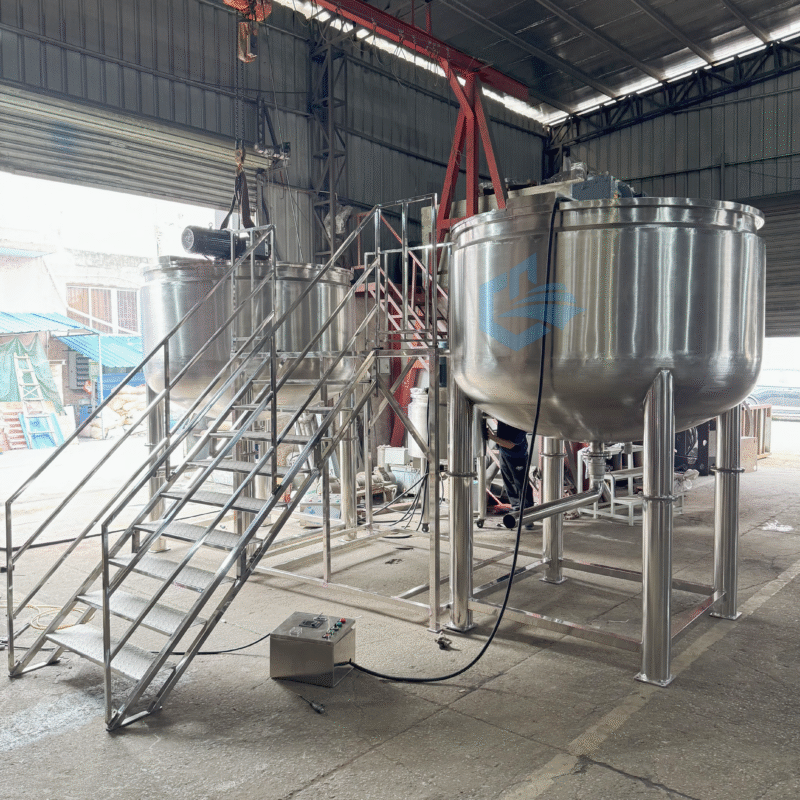
Cooling Stirring Tank: From “Temperature Control” to “Efficiency Enhancement”, the Core Carrier of Chemical Cooling Processes

In the continuous flow of chemical production, the synergy between cooling and stirring is often a key factor determining reaction efficiency and product quality. As specialized equipment integrating low-temperature regulation and uniform mixing, cooling stirring tanks are evolving from traditional “passive cooling” to a composite function of “precision temperature control + high-efficiency mixing”, becoming the core carrier connecting processes such as endothermic reactions, material cooling, and crystallization separation.
The core competitiveness of cooling stirring tanks first lies in the “targeted” design of their cooling systems. Unlike a single cooling demand, chemical materials often have strict requirements for cooling rate and temperature uniformity—for example, esterification reactions in fine chemicals require gradient cooling to avoid by-product formation, while food additive production demands temperature fluctuations of no more than ±1℃ during low-temperature stirring. To address this, modern cooling stirring tanks mostly adopt jacketed or coiled cooling structures: the jacket layer forms a “constant temperature barrier” through circulating low-temperature media (such as chilled water or ethylene glycol solutions), combined with internal guide plates to reduce local temperature differences; the coiled design inserts cooling elements directly into the material, increasing heat exchange area to improve cooling efficiency, especially suitable for cooling high-viscosity materials.
The “synergistic” design of the stirring system is equally crucial. During cooling, temperature gradients in materials can easily cause local solidification or uneven reactions. Therefore, the stirring paddle type must be precisely matched with the cooling method: anchor-shaped paddles rotate close to the tank wall, enhancing wall heat transfer during jacket cooling and preventing material from sticking to the wall and scaling; propeller-shaped paddles generate strong axial convection, cooperating with coil cooling to achieve rapid overall cooling of materials. Some high-end equipment is also equipped with variable frequency speed control systems, which can dynamically adjust stirring speed based on real-time temperature feedback—for instance, in crystallization processes, high-speed stirring initially accelerates cooling, while low-speed stirring later reduces crystal breakage, improving product purity through “stirring-cooling” linkage.
With the chemical industry’s rising requirements for energy consumption and safety, intelligent transformation of cooling stirring tanks has become a new trend. Built-in temperature sensors and flow transmitters can real-time monitor the temperature of cooling media, material temperature, and stirring torque. After data is uploaded to the control system, it automatically adjusts the flow of cooling media or stirring power to achieve “on-demand cooling”. Practice in a pharmaceutical intermediate factory shows that intelligent cooling stirring tanks reduce energy consumption in the cooling stage by 20% through precise temperature control, while product qualification rates rise to 99.5% due to reduced temperature fluctuations. Additionally, the popularization of explosion-proof designs and pressure alarm devices enhances safety redundancy when handling flammable and explosive materials, providing reliable guarantees for high-risk chemical scenarios.
From laboratory small-scale tests to industrial mass production, the evolution of cooling stirring tanks has always centered on the three core principles of “precision temperature control, high-efficiency mixing, and safe energy conservation”. It is not only the physical carrier of chemical cooling processes but also reflects the industry’s in-depth shift from extensive production to refinement and intelligence—under the dual demands of cost reduction, efficiency enhancement, and green development, such “small yet sophisticated” equipment is becoming a microcosmic fulcrum for upgrading the chemical industry chain.